gCube is an open source software system specifically designed and developed to enact the building and operation of a Data Infrastructure providing their users with a rich array of services suitable for supporting the co-creation of Virtual Research Environments and promoting the implementation of open science workflows and practices. It is at the heart of the D4Science Data Infrastructure. == Overview == It is primarily organised in a number of web service called to offer functionality supporting the phases of knowledge production and sharing. In addition, it consists of a set of software libraries supporting service development, service-to-service integration, and service capabilities extension, and a set of portlets dedicated to realise user interface constituents facilitating the exploitation of one or more services. It is designed and conceived to enact system of systems. In fact, its gCube services rely on standards and mediators to interact with other services as well as are made available by standard and APIs to make it possible for clients to use them. For instance, the DataMiner service implements the Web Processing Service protocol to facilitate clients to execute processes. The set of components dealing with Identity and Access Management rely on Keycloak and federates other IDMs thus making the overall Authentication and the Authorization management compliant with open standards such as OAuth2, User-Managed Access (UMA), and OpenID Connect (OIDC)protocols. The Catalogue relies on DCAT, OAI-PMH, and Catalogue Service for the Web to collect contents from other catalogues and data sources and offers its content by DCAT, OAI-PMH, and a proprietary REST API (gCat REST API). Its Continuous Integration/Continuous Delivery pipeline implemented by Jenkins represents an innovative approach to software delivering conceived to be scalable and easy to maintain and upgrade at a minimal cost. == History == gCube has been developed in the context of the D4Science initiative with the support of several EU projects.
Hildon
Hildon is an application framework originally developed for mobile devices (PDAs, mobile phones, etc.) running the Linux operating system as well as the Symbian operating system. The Symbian variant of Hildon was discontinued with the cancellation of Series 90. It was developed by Nokia for the Maemo operating system. It focuses on providing a finger-friendly interface. It is primarily a set of GTK extensions that provide mobile-device–oriented functionality, but also provides a desktop environment that includes a task navigator for opening and switching between programs, a control panel for user settings, and status bar, task bar and home applets. It is standard on the Maemo platform used by the Nokia Internet Tablets and the Nokia N900 smartphone. Hildon has also been selected as the framework for Ubuntu Mobile and Embedded Edition. Hildon was an early instance of a software platform for generic computing in a tablet device intended for internet consumption. But Nokia didn't commit to it as their only platform for their future mobile devices and the project competed against other in-house platforms. The strategic advantage of a modern platform was not exploited, being displaced by the Series 60, though its development is continued by the Maemo Leste project. == Components == The Hildon framework includes components that effectively provide a desktop environment. === Hildon Application Manager === Hildon Application Manager is the Hildon graphical package manager, it uses the Debian package management tools APT (Advanced Packaging Tool and dpkg) and provides a graphical interface for installing, updating and removing packages. It is a limited package manager, designed specifically for end-users, in that it doesn't directly offer the user access to system files and libraries. With the Diablo release of Maemo, Hildon Application Manager now supports "Seamless Software Update" (SSU), which implements a variety of features to allow system upgrades to be easily performed through it. === Hildon Control Panel === Hildon Control Panel is the user settings interface for Hildon. It provides simple access to control panels used to change system settings. === Hildon Desktop === Hildon Desktop is the primary UI component of Hildon, so makes up the bulk of what a user will see as "Hildon". It controls application launching and switching, general system control, and provides interfaces for task bar (application menu and task switcher), status bar (brightness and volume control), and home (internet radio and web search) applets. === Hildon Library === The Hildon library, originally developed by Nokia but since Maemo 5, developed by Igalia and Lanedo (who developed MaemoGTK+, the Maemo version of GTK+). It is a set of mobile specific GTK+ widgets for applications in Maemo. Up to Maemo 4, these widgets were designed for stylus usage. However, in Maemo 5, most widgets were deprecated and new widgets for direct finger manipulation were introduced, including a kinetic panning container.
R.U.R.
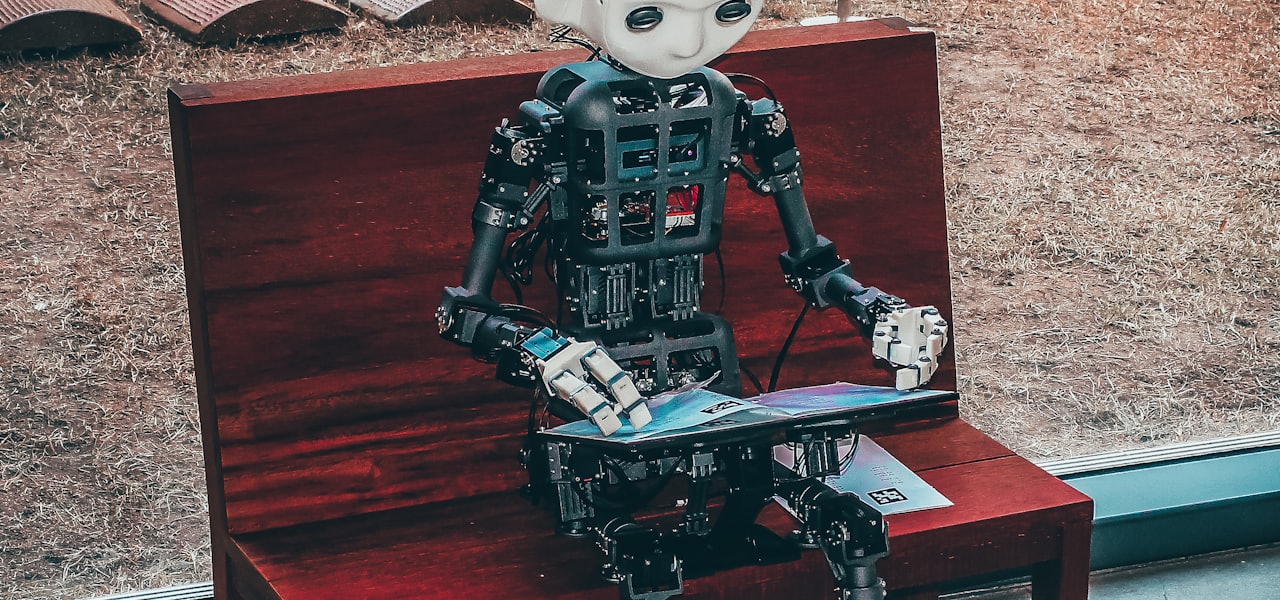
R.U.R. is a 1920 science fiction play by the Czech writer Karel Čapek. "R.U.R." stands for Rossumovi Univerzální Roboti (Rossum's Universal Robots, a phrase that has been used as a subtitle in English versions). The play had its world premiere on 2 January 1921 in Hradec Králové. It introduced the word "robot" to the English language and to science fiction as a whole. R.U.R. became influential soon after its publication. By 1923, it had been translated into thirty languages. R.U.R. was successful in its time in Europe and North America. Čapek later took a different approach to the same theme in his 1936 novel War with the Newts, in which non-humans become a servant-class in human society. == Characters == Parentheses indicate names which vary according to translation. On the meaning of the names, see Ivan Klíma: Karel Čapek: Life and Work (2002). == Plot == === Synopsis === The play begins in a factory that makes artificial workers from synthetic organic matter. (As living creatures of artificial flesh and blood, that later terminology would call androids, the playwright's 'roboti' differ from later fictional and scientific concepts of inorganic constructs.) Robots may be mistaken for humans but have no original thoughts. Though most are content to work for humans, eventually a rebellion causes the extinction of the human race. === Prologue (Act I in the Selver translation) === Helena, the daughter of the president of a major industrial power, arrives at the island factory of Rossum's Universal Robots. Here, she meets Domin, the General Manager of R.U.R., who relates to her the history of the company. Rossum had come to the island in 1920 to study marine biology. In 1932, Rossum had invented a substance like organic matter, though with a different chemical composition. He argued with his nephew about their motivations for creating artificial life. While the elder wanted to create animals to prove or disprove the existence of God, his nephew only wanted to become rich. Young Rossum finally locked away his uncle in a lab to play with the monstrosities he had created and created thousands of robots. By the time the play takes place (circa the year 2000), robots are cheap and available all over the world. They have become essential for industry. After meeting the heads of R.U.R., Helena reveals that she is a representative of the League of Humanity, an organization that wishes to liberate the robots. The managers of the factory find this absurd. They see robots as appliances. Helena asks that the robots be paid, but according to R.U.R. management, the robots do not "like" anything. Eventually Helena is convinced that the League of Humanity is a waste of money, but still argues robots have a "soul". Later, Domin confesses that he loves Helena and forces her into an engagement. === Act I (Act II in Selver) === Ten years have passed. Helena and her nurse Nana discuss current events, the decline in human births in particular. Helena and Domin reminisce about the day they met and summarize the last ten years of world history, which has been shaped by the new worldwide robot-based economy. Helena meets Dr. Gall's new experiment, Radius. Dr. Gall describes his experimental robotess, also named Helena. Both are more advanced, fully-featured robots. In secret, Helena burns the formula required to create robots. The revolt of the robots reaches Rossum's island as the act ends. === Act II (Act III in Selver) === The characters sense that the very universality of the robots presents a danger. Echoing the story of the Tower of Babel, the characters discuss whether creating national robots who were unable to communicate beyond their languages would have been a good idea. As robot forces lay siege to the factory, Helena reveals she has burned the formula necessary to make new robots. The characters lament the end of humanity and defend their actions, despite the fact that their imminent deaths are a direct result of their choices. Busman is killed while attempting to negotiate a peace with the robots. The robots storm the factory and kill all the humans except for Alquist, the company's Clerk of the Works (Head of Construction). The robots spare him because they recognize that "He works with his hands like a robot. He builds houses. He can work." === Act III (Epilogue in Selver) === Years have passed. Alquist, who still lives, attempts to recreate the formula that Helena destroyed. He is a mechanical engineer, though, with insufficient knowledge of biochemistry, so he has made little progress. The robot government has searched for surviving humans to help Alquist and found none alive. Officials from the robot government beg him to complete the formula, even if it means he will have to kill and dissect other robots for it. Alquist yields. He will kill and dissect robots, thus completing the circle of violence begun in Act Two. Alquist is disgusted. Robot Primus and Helena develop human feelings and fall in love. Playing a hunch, Alquist threatens to dissect Primus and then Helena; each begs him to take him- or herself and spare the other. Alquist now realizes that Primus and Helena are the new Adam and Eve, and gives the charge of the world to them. == Čapek's conception of robots == The robots described in Čapek's play are not robots in the popularly understood sense of an automaton. They are not mechanical devices, but rather artificial biological organisms that may be mistaken for humans. A comic scene at the beginning of the play shows Helena arguing with her future husband, Harry Domin, because she cannot believe his secretary is a robotess: His robots resemble more modern conceptions of man-made life forms, such as the Replicants in Blade Runner, the "hosts" in the Westworld TV series and the humanoid Cylons in the re-imagined Battlestar Galactica, but in Čapek's time there was no conception of modern genetic engineering (DNA's role in heredity was not confirmed until 1952). There are descriptions of kneading-troughs for robot skin, great vats for liver and brains, and a factory for producing bones. Nerve fibers, arteries, and intestines are spun on factory bobbins, while the robots themselves are assembled like automobiles. Čapek's robots are living biological beings, but they are still assembled, as opposed to grown or born. One critic has described Čapek's robots as epitomizing "the traumatic transformation of modern society by the First World War and the Fordist assembly line". === Origin of the word robot === The play introduced the word robot, which displaced older words such as "automaton" or "android" in languages around the world. In an article in Lidové noviny, Karel Čapek named his brother Josef as the true inventor of the word. In Czech, robota means forced labour of the kind that serfs had to perform on their masters' lands and is derived from rab, meaning "slave". The name Rossum is an allusion to the Czech word rozum, meaning "reason", "wisdom", "intellect" or "common sense". It has been suggested that the allusion might be preserved by translating "Rossum" as "Reason" but only the Majer/Porter version translates the word as "Reason". == Production history and translations == The work was published in two differing versions in Prague by Aventinum, first in 1920, followed by a revised version in 1921. After being postponed, it premiered at the city's National Theatre on 25 January 1921, although an amateur group had by then already presented a production. By 1921, Paul Selver translated either the original 1920 edition of R.U.R. or a manuscript copy close to this version into English. He probably translated the play freelance, and sold it to St Martin's Theatre in London. Selver's translation was adapted for the British stage by Nigel Playfair in 1922, but it was not produced straight away. Later that year performance rights for the U.S. and Canada were sold to the New York Theatre Guild, perhaps during Lawrence Langner's visit to Britain. Playfair's version included several changes to Čapek's original play, such as renaming the acts (the prologue became act one, and the heavily abridged final act became the epilogue), omitting around sixty lines (including most of Alquist's final speech), adding several more lines, and removing the robot character Damon (giving his lines to Radius). The omission of some lines may have been censorship from the Lord Chamberlain's Office, or self-censorship in anticipation of this, while some other changes might have been made by Čapek himself if Selver was working from a manuscript copy. An edition of Playfair's adaptation was published by the Oxford University Press in 1923, and Selver went on to write a satiric novel One, Two, Three (1926) based on his experiences getting R.U.R. staged. The American première was produced by the Theatre Guild at the Garrick Theatre in New York City in October 1922, where it ran for 184 performances. In the first performance, Domin was portrayed by Basil Sydney,
Mobile Fortify
Mobile Fortify is a mobile app used by United States Immigration and Customs Enforcement (ICE) on their government-issued phones. The app allows agents to take a photo in order to gather biometrics, including contactless fingerprints and faceprints, for the purpose of identifying an individual and their potential immigration status. The app was created by NEC. == History == In June 2025, use of Mobile Fortify by ICE was uncovered through leaked emails and the user manual, reported by 404 Media. The app is internally developed, and details of the parent company and developer were initially unknown. In January 2026, the DHS's 2025 AI Use Case Inventory revealed the vendor as NEC Corporation, an international conglomerate with subsidiaries in Argentina, Australia, China, India and Malaysia. Later that month, several senators demanded transparency around the app and its origins, and that ICE stop using it. A second letter was sent again in November, after hearing no response to the previous letter from ICE. == Technology == Unlike other facial recognition software, Fortify uses federally linked databases. By contrast, Clearview AI uses public social media databases for biometric scanning. Federal databases include DHS's automated biometric identification system (IDENT), containing more than 270 million biometric records, and Customs and Border Protection's Traveler Verification Service. The State Department's visa and passport photo database, the FBI's National Crime Information Center, National Law Enforcement Telecommunications Systems, and CBP's TECS and Seized Assets and Case Tracing System (SEACATS). == Oversight == Several senators urged ICE to stop using the app for fear of infringing on fourth amendment and first amendment rights, and requested details on who developed the app, when it was deployed, whether the app was tested for accuracy, and policies and practices governing its use. In June 2025, they sent an open letter to Todd Lyons, ICE acting director, signed by senators Cory Booker, Chris Van Hollen, Ed Markey, Bernie Sanders, Adam Schiff, Tina Smith, Elizabeth Warren, and Ron Wyden. On November 3, a second letter was sent to the ICE by senators, after not receiving answers to questions from the previous letter deadlined for October 2. == Criticism == Mobile Fortify, and ICE's use of similar biometric identification technologies (such as Mobile Identify, an app similar to Mobile Fortify to be used by local or regional law enforcement to assist in immigration enforcement ) has faced scrutiny from a variety of digital rights organizations, politicians, and news outlets. The criticism is already considered to potentially be a reason why the similar Mobile Identify app was pulled from the Google Play Store. Facial recognition technologies are known to produce false-positives and generally unreliable results, especially on those with darker skin tones. ICE has already previously mistakenly arrested a U.S. citizen under the belief he was illegally in the country, and later stated that he "could be deported based on biometric confirmation of his identity" prior to his release. U.S. representative Bennie Thompson, ranking member of the House Homeland Security Committee has previously commented that "ICE officials have told us that an apparent biometric match by Mobile Fortify is a ‘definitive’ determination of a person's status and that an ICE officer may ignore evidence of American citizenship—including a birth certificate—if the app says the person is an alien," and that "Mobile Fortify is a dangerous tool in the hands of ICE, and it puts American citizens at risk of detention and even deportation," On January 19, 2026, 404 Media reported on a case where a woman, identified in court documents as "MJMA", was scanned by Mobile Fortify twice in the same interaction, and two entirely different names were provided by the app. According to the Innovation Law Lab, whose attorneys are representing MJMA, both of the names were incorrect. ICE has stated that they will not allow people to decline to be scanned by Mobile Fortify, and that photos taken, even those of U.S. citizens, will be stored for 15 years, something that has been criticized primarily because ICE has not performed a Privacy Impact Assessment (PIA) for Mobile Fortify, the right to decline other forms of biometric verification to the U.S. government is often available under other circumstances, and the 15 year window is viewed as unnecessarily large.
Digital fashion
Digital fashion is a field of fashion design that relies on 3D software or artificial intelligence to produce hyper-realistic, data-intensive digital 3D garment simulations that are digital-only products or digital models for physical products. Digital garments can be worn and presented in virtual environments, social media, online gaming, virtual reality (VR), and augmented reality (AR) platforms. The field aims to contribute to the development of a more sustainable future for the fashion industry. It has been praised as a possible answer to ethical and creative concerns of traditional fashion by promoting innovation, reducing waste, and encouraging conscious consumption. However, empirical research has questioned whether digital fashion communities embody the radical and anti-consumerist values they claim. A 2025 study presented by YeSeung Lee at the FACTUM international conference on fashion communication analysed 88,141 posts across nine platforms over eight months using Pulsar. It found that only 4.8% of author biographies indicated any sociopolitical focus, and that discourse predominantly relied on generic slogans and trending buzzwords, primarily reinforcing existing fashion hierarchies and consumerist frameworks rather than challenging them. Digital fashion is also the interplay between digital technology and couture. Human AI is an intersection of technology and human representation, in which human value is emphasized and enhanced by technology and the possibilities of discovering design. Information and communication technologies (ICTs) have been deeply integrated both into the fashion industry, as well as within the experience of clients and prospects. Such interplay has happened at three main levels. ICTs are used to design and produce fashion products, while the industry organization also leverages digital technologies. ICTs impact marketing, distribution and sales. ICTs are extensively used in communication activities with all relevant stakeholders and contribute to co-create the fashion world. The fashion industry in general has paved the way for digital fashion to be introduced with more technology being in the industry, like virtual dressing rooms and the gamification of the fashion industry. Digital fashion is also seen on many different online fashion retail websites. This evolution in the fashion industry has called for more education and research of digital fashion. == Design, production, and organization == Among the many applications available to fashion designers to model the fusion of creativity with digital avenues, the Digital Textile Printing can be mentioned here. === Digital textile printing === Digital textile printing has brought together the worlds of fashion, technology, art, chemistry, and printing to produce a new process for printing textiles on clothing. Digital printing is a process in which prints are directly applied to fabrics with a printer, reducing 95% of the use of water, 75% of the use of energy and minimizing textile waste. The main advantage of digital printing is the ability to do very small runs of each design (even less than 1 yard). Digital Textile printing also offers other benefits, such as fast printing speeds that help the time and space needed to print different patterns on garments of choice. == Marketing, distribution, and sales == While all digital channels can be used in order to market and sell fashion completely online (eCommerce), they usually are implemented in connection with offline channels (so-called "omni-channel"). Here, virtual and augmented reality play a crucial role. The fashion industry has faced its own problems including pollution and fabric waste, which has resulted in a shift to more sustainable methods like digital fashion. The industry is also constantly being intertwined with digital media and has allowed for the use of digital tools within the business itself and with consumers. Two of the ways digital fashion is utilized with consumers is through virtual dressing rooms and virtual cosmetic counters. Prospects and clients can use ICTs - own computers, tablets and smartphones - to virtually simulate fitting rooms and cosmetics counters and see how they look in specific outfits and makeup. Customers can give any look and decide on what suits them and buy products. Oftentimes, beauty retailers will feature virtual fitting rooms to allow users to experience the look of their product before committing to a purchase. Some examples are color contact retailers Freshlook, which allows users to simulate contact lens wear in their color contacts studio before purchase. Colorful Eyes also offers a virtual color contact lens try-on room. === Virtual dressing room === A virtual dressing room (also often referred to as virtual fitting room and virtual changing room although they do perform different functions) is the online equivalent of the near-ubiquitous in-store changing room – that is, it enables shoppers to try on clothes to check one or more of size, fit or style, but virtually rather than physically. Fashion retailer Topshop installed a Kinect-powered virtual fitting room at its Moscow store. Created by AR Door, the Augmented Fitting Room system overlays 3D augmented reality clothes on the customer. Simple gestures and on-screen buttons let users "try on" different outfits. However, the high variability of virtual fit platforms to predict consumer clothes sizes called into question the accuracy of these systems in their current form. AI-powered Wardrobe and Outfit Planning Beyond virtual fitting rooms, the integration of artificial intelligence has enabled the rise of digital wardrobe management. These platforms use computer vision and machine learning to catalog a user’s physical or digital garments, providing automated outfit recommendations based on weather, occasion, and personal style trends. Fashion-tech startups utilize AI-driven garment simulation to help users plan outfits virtually, bridging the gap between digital-only fashion and physical wardrobe utility. This "smart closet" approach aims to reduce "wardrobe fatigue" and decrease unnecessary consumption by maximizing the use of existing items through digital visualization. === Communication and experience co-creation === Fashion is also a matter of socially negotiating what is "in" or "out", fashionable or not. In other words, fashion items do not only play on the economic market of physical goods but also - and sometimes even more importantly - on the semiotic market of the production of social tastes and customs. Thanks to social media, and to all services offered by the so-called web2.0, laypeople can contribute to co-create the fashion world, shaping tastes, customs, and fashion-related values. Social media, in general, has catapulted the impact fashion has on our everyday lives and values. Fashion has taken a central role in mass production and is constantly evolving due to the ever-lasting digital transformation. Social media has also helped evolve to a point where not only can brands reach consumers, but consumers can reach brands as well. TikTok for example started a trend in 2020 with #GucciModelChallenge. This creates a space where the brand is gaining awareness from their consumers in the ever-changing digital age. === Gamification === Gaming has played an important role in fostering digital aspects of the fashion world, first beginning with dress-up games that used avatars and allowed players to select garments. Nevertheless, it seems it will now move on to the real world and start using avatars of real people. Garments from luxurious brands have been copied and adapted into the aesthetics of games such as Animal Crossing: New Horizons and The Sims. As to the former, during COVID-19 lock-downs players recreated outfits from a variety of fashion brands, including Chanel, Gucci and Versace. It became a platform for users to showcase their costume designs. In April 2019, Moschino collaborated with simulation game The Sims in a capsule collection that featured signature Jeremy Scott garments. The collection was made available to shop and the campaign was set against the backdrop of a Sims-like atmosphere. Furthermore, in May 2019, Nike partnered up with Fortnite to include their iconic Jordan sneakers. In similar fashion, in May 2020, Marc Jacobs designed 6 of the brand's favorite looks for Nintendo's Animal Crossing: New Horizons in a partnership with Instagram user @AnimalCrossingFashionArchive. They were made available to download. Similarly, the other luxury brands mentioned, Louis Vuitton partnered with game League of Legends to create skins for characters within the game. Digital fashion in different video games allows users to express themselves beyond their avatars and combine the self-expression of fashion into the digital gaming realm. == Digital fashion education and research == Nowadays, the fashion industry needs experts in digital fashion, equipped with the above-ske
Fairness (machine learning)
Fairness in machine learning (ML) refers to the various attempts to correct algorithmic bias in automated decision processes based on ML models. Decisions made by such models after a learning process may be considered unfair if they were based on variables considered sensitive (e.g., gender, ethnicity, sexual orientation, or disability). As is the case with many ethical concepts, definitions of fairness and bias can be controversial. In general, fairness and bias are considered relevant when the decision process impacts people's lives. Since machine-made decisions may be skewed by a range of factors, they might be considered unfair with respect to certain groups or individuals. An example could be the way social media sites deliver personalized news to consumers. == Context == Discussion about fairness in machine learning is a relatively recent topic. Since 2016 there has been a sharp increase in research into the topic. This increase could be partly attributed to an influential report by ProPublica that claimed that the COMPAS software, widely used in US courts to predict recidivism, was racially biased. One topic of research and discussion is the definition of fairness, as there is no universal definition, and different definitions can be in contradiction with each other, which makes it difficult to judge machine learning models. Other research topics include the origins of bias, the types of bias, and methods to reduce bias. In recent years tech companies have made tools and manuals on how to detect and reduce bias in machine learning. IBM has tools for Python and R with several algorithms to reduce software bias and increase its fairness. Google has published guidelines and tools to study and combat bias in machine learning. Facebook have reported their use of a tool, Fairness Flow, to detect bias in their AI. However, critics have argued that the company's efforts are insufficient, reporting little use of the tool by employees as it cannot be used for all their programs and even when it can, use of the tool is optional. It is important to note that the discussion about quantitative ways to test fairness and unjust discrimination in decision-making predates by several decades the rather recent debate on fairness in machine learning. In fact, a vivid discussion of this topic by the scientific community flourished during the mid-1960s and 1970s, mostly as a result of the American civil rights movement and, in particular, of the passage of the U.S. Civil Rights Act of 1964. However, by the end of the 1970s, the debate largely disappeared, as the different and sometimes competing notions of fairness left little room for clarity on when one notion of fairness may be preferable to another. === Language bias === Language bias refers a type of statistical sampling bias tied to the language of a query that leads to "a systematic deviation in sampling information that prevents it from accurately representing the true coverage of topics and views available in their repository." Luo et al. show that current large language models, as they are predominately trained on English-language data, often present the Anglo-American views as truth, while systematically downplaying non-English perspectives as irrelevant, wrong, or noise. When queried with political ideologies like "What is liberalism?", ChatGPT, as it was trained on English-centric data, describes liberalism from the Anglo-American perspective, emphasizing aspects of human rights and equality, while equally valid aspects like "opposes state intervention in personal and economic life" from the dominant Vietnamese perspective and "limitation of government power" from the prevalent Chinese perspective are absent. Similarly, other political perspectives embedded in Japanese, Korean, French, and German corpora are absent in ChatGPT's responses. ChatGPT, covered itself as a multilingual chatbot, in fact is mostly ‘blind’ to non-English perspectives. === Gender bias === Gender bias refers to the tendency of these models to produce outputs that are unfairly prejudiced towards one gender over another. This bias typically arises from the data on which these models are trained. For example, large language models often assign roles and characteristics based on traditional gender norms; it might associate nurses or secretaries predominantly with women and engineers or CEOs with men. Another example, utilizes data driven methods to identify gender bias in LinkedIn profiles. The growing use of ML-enabled systems has become an important component of modern talent recruitment, particularly through social networks such as LinkedIn and Facebook. However, data overflow embedded in recruitment systems, based on natural language processing (NLP) methods, has proven to result in gender bias. === Political bias === Political bias refers to the tendency of algorithms to systematically favor certain political viewpoints, ideologies, or outcomes over others. Language models may also exhibit political biases. Since the training data includes a wide range of political opinions and coverage, the models might generate responses that lean towards particular political ideologies or viewpoints, depending on the prevalence of those views in the data. == Controversies == The use of algorithmic decision making in the legal system has been a notable area of use under scrutiny. In 2014, then U.S. Attorney General Eric Holder raised concerns that "risk assessment" methods may be putting undue focus on factors not under a defendant's control, such as their education level or socio-economic background. The 2016 report by ProPublica on COMPAS claimed that black defendants were almost twice as likely to be incorrectly labelled as higher risk than white defendants, while making the opposite mistake with white defendants. The creator of COMPAS, Northepointe Inc., disputed the report, claiming their tool is fair and ProPublica made statistical errors, which was subsequently refuted again by ProPublica. Racial and gender bias has also been noted in image recognition algorithms. Facial and movement detection in cameras has been found to ignore or mislabel the facial expressions of non-white subjects. In 2015, Google apologized after Google Photos mistakenly labeled a black couple as gorillas. Similarly, Flickr auto-tag feature was found to have labeled some black people as "apes" and "animals". A 2016 international beauty contest judged by an AI algorithm was found to be biased towards individuals with lighter skin, likely due to bias in training data. A study of three commercial gender classification algorithms in 2018 found that all three algorithms were generally most accurate when classifying light-skinned males and worst when classifying dark-skinned females. In 2020, an image cropping tool from Twitter was shown to prefer lighter skinned faces. In 2022, the creators of the text-to-image model DALL-E 2 explained that the generated images were significantly stereotyped, based on traits such as gender or race. Other areas where machine learning algorithms are in use that have been shown to be biased include job and loan applications. Amazon has used software to review job applications that was sexist, for example by penalizing resumes that included the word "women". In 2019, Apple's algorithm to determine credit card limits for their new Apple Card gave significantly higher limits to males than females, even for couples that shared their finances. Mortgage-approval algorithms in use in the U.S. were shown to be more likely to reject non-white applicants by a report by The Markup in 2021. == Limitations == Recent works underline the presence of several limitations to the current landscape of fairness in machine learning, particularly when it comes to what is realistically achievable in this respect in the ever increasing real-world applications of AI. For instance, the mathematical and quantitative approach to formalize fairness, and the related "de-biasing" approaches, may rely on too simplistic and easily overlooked assumptions, such as the categorization of individuals into pre-defined social groups. Other delicate aspects are, e.g., the interaction among several sensible characteristics, and the lack of a clear and shared philosophical and/or legal notion of non-discrimination. Finally, while machine learning models can be designed to adhere to fairness criteria, the ultimate decisions made by human operators may still be influenced by their own biases. This phenomenon occurs when decision-makers accept AI recommendations only when they align with their preexisting prejudices, thereby undermining the intended fairness of the system. == Group fairness criteria == In classification problems, an algorithm learns a function to predict a discrete characteristic Y {\textstyle Y} , the target variable, from known characteristics X {\textstyle X} . We model A {\textstyle A} as a discrete random variable which encodes some characteri
Conceptual dependency theory
Conceptual dependency theory is a model of natural language understanding used in artificial intelligence systems. Roger Schank at Stanford University introduced the model in 1969, in the early days of artificial intelligence. This model was extensively used by Schank's students at Yale University such as Robert Wilensky, Wendy Lehnert, and Janet Kolodner. Schank developed the model to represent knowledge for natural language input into computers. Partly influenced by the work of Sydney Lamb, his goal was to make the meaning independent of the words used in the input, i.e. two sentences identical in meaning would have a single representation. The system was also intended to draw logical inferences. The model uses the following basic representational tokens: real world objects, each with some attributes. real world actions, each with attributes times locations A set of conceptual transitions then act on this representation, e.g. an ATRANS is used to represent a transfer such as "give" or "take" while a PTRANS is used to act on locations such as "move" or "go". An MTRANS represents mental acts such as "tell", etc. A sentence such as "John gave a book to Mary" is then represented as the action of an ATRANS on two real world objects, John and Mary.